


Few temples in India stand as close to a cremation ground as Maa Tara's temple at Tarapith. Just behind it, on the bank of the Dwarka, lies the Mahashmashan, and around it has grown one of the most talked-about wonders of Bengal: a body comes to the cremation ground every single day, once in the morning and again at around 4 in the afternoon. No one arranges it and there is no rule behind it, yet locals say it has never failed. Here is the story, the beliefs that go with it, and why devotees see it as Maa Tara's own leela.
- The Mahashmashan: the great cremation ground beside Maa Tara's temple, one of the most revered Tantric sites in India
- The wonder: a body arrives every day in the morning and again at around 4 PM, without anyone planning it
- Not a rule: nothing is fixed by the temple; it is simply what devotees and locals say happens, day after day
- Related beliefs: the morning aarti waits for a pyre, and the bhog follows a cremation
The Mahashmashan of Tarapith
The Mahashmashan stretches along the Dwarka river behind the temple. Families from the villages of Birbhum and beyond bring their dead here, believing that a soul cremated in Maa Tara's own ground is blessed by her. Local accounts say bodies come for cremation every single day, even in the monsoon, when the river floods the ground.
For Tantric seekers the cremation ground is not a place of fear. It is where the sage Vashishtha and the saint Bamakhepa meditated on the seat of five skulls, the Panchamundi asan, under a white silk-cotton tree. Sadhaks still sit here at night, above all on new moons. To understand the beliefs below, read the history of Tarapith temple first.
A body every morning, and another at 4 PM
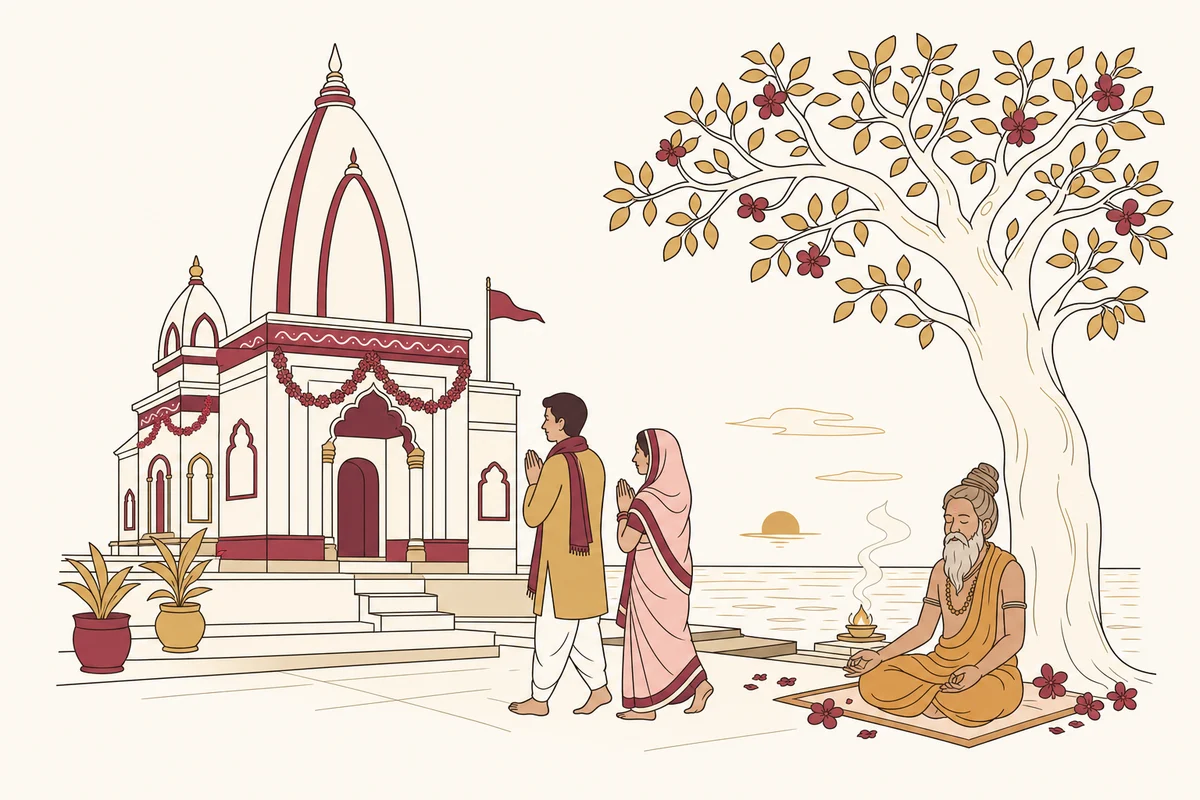
Ask anyone who lives near the Mahashmashan, a priest, a shopkeeper or a sadhak, and you will hear the same thing: every day, a body is brought for cremation in the morning, and another arrives at around 4 in the afternoon. It is not a rule, and no one sends for them. Families come from villages near and far on their own, and yet, devotees say, the ground is never without a pyre at those hours.
Locals tell how even in the monsoon, when the Dwarka floods the cremation ground, at least one body still comes each day. For devotees there is only one explanation: the cremation ground is Maa Tara's own home, and she never leaves it empty. They see it as her leela, her divine play, a daily reminder that she is the Mother of both life and death.
No register of these times is published, so the hours are what people who live and work here describe rather than a recorded count. That is part of why the story is told with such wonder.
Belief 1: the morning aarti waits for a funeral pyre
The most widely reported belief is that Maa Tara's morning aarti begins only after a funeral pyre has been lit at the Mahashmashan. News features on Tarapith describe it as a local belief rooted in Tantra: the Goddess begins her day only once the spiritual energy of the cremation ground is awakened by the fire of a pyre.
Behind it lies an old idea about Tara herself. In Tantric images, Ugra Tara stands on a burning pyre, and the pyre is called her seat. It stands for the fire of knowledge, jnanagni, which burns away ego and attachment. A pyre burning before her morning worship is, for believers, the Mother taking her seat.
Belief 2: the bhog is offered only after a cremation
A related piece of folklore, often repeated by visitors and in food and travel writing, says that Maa Tara's bhog is not offered until there has been a cremation at the Mahashmashan that day.
The bhog at Tarapith is itself unlike most temples. Following Shakta and Tantric tradition, it includes fish and meat along with rice and sweets, and the prasad is shared with devotees. For Tantra, nothing in creation is pure or impure in itself; life and death, the temple and the cremation ground, belong to the same Mother. A day of worship that begins beside the pyres expresses exactly that.
Belief 3: the fire of the Mahashmashan never goes out
Devotees often say that the fire of the Mahashmashan never goes out, and that even when floods fill the cremation ground, the pyres are not put out. With a body arriving every morning and every afternoon, believers say, the Mother's fire is always kept alive.
What is on record, and what is not
It helps to separate belief from practice:
- On record: the Mahashmashan is an active cremation ground beside the temple, cremations take place daily, and the temple keeps a daily schedule of morning darshan, a midday bhog break and evening aarti.
- Told by locals: that a body arrives every morning and again at around 4 PM. It is not a rule of any kind; it is what people here say they see every day.
- Reported as belief: that the morning aarti waits for a pyre, and that the bhog follows a cremation. These are told by devotees and in features about the temple, but the temple committee does not publish them as written rules.
None of this makes the beliefs less meaningful. At Tarapith, faith has always lived side by side with the cremation ground, and the stories are a way devotees speak about the Mother who rules over both life and death.
Other beliefs about the Mahashmashan
- Lights in the dark: people speak of lights seen in the cremation ground at night, and say no one should walk towards them.
- The river that flows north: the Dwarka is said to turn north here, which is considered especially sacred.
- The seat of siddhi: sitting on the Panchamundi asan with an impure mind is believed to bring burning pain; only a true sadhak can sit there.
These are beliefs, passed on by word of mouth; local writers who record them say so themselves.
Visiting the Mahashmashan respectfully
- Remember it is a cremation ground: families come here in grief. Keep your distance from pyres and funeral parties, and do not photograph or film them.
- Go in daylight: the ground is large and dark at night. Night-time sadhana is for practitioners; visitors are safer in the day.
- Be careful with offers: do not follow strangers who offer special rituals, tantric remedies or "siddhi" for money.
- New moons are crowded: on Amavasya and Kaushiki Amavasya, the temple and the ground are packed; keep children and elders close.
For darshan hours and the midday bhog break, see Tarapith temple timings.
MandirMay is bringing Tarapith to its temple list soon, with help for darshan, stay and local travel. Until then, explore the temples we already serve.
Frequently asked questions
Does the morning aarti at Tarapith wait for a funeral pyre?
That is a widely reported local belief: the morning aarti begins only after a pyre is lit at the Mahashmashan. It comes from Tantric tradition, in which the burning pyre is Maa Tara's seat. The temple does not publish it as a written rule.
Is Maa Tara's bhog offered only after a cremation?
Folklore says so: the bhog is not offered until there has been a cremation that day. It is a belief told by devotees, not a rule announced by the temple.
Is it true that a body comes to Tarapith every morning and at 4 PM?
That is what locals and regular visitors say: a body arrives every day in the morning and again at around 4 in the afternoon. It is not a rule and no one arranges it; devotees see it as Maa Tara's leela. No register of the times is published.
Is there a rule about when bodies must come to the Tarapith cremation ground?
No. There is no rule and no fixed time. Families bring their dead whenever they come; the morning and 4 PM arrivals are simply what people here say happens every day.
Do cremations happen every day at Tarapith?
Yes. Local accounts say bodies come to the Mahashmashan every day, even during monsoon floods.
Why is there a cremation ground next to Tarapith temple?
In Tantric belief Maa Tara loves the cremation ground and the burning pyre is her seat. Sages and saints such as Vashishtha and Bamakhepa attained siddhi there, which is why the Mahashmashan is as sacred as the temple.
Can visitors go to the Tarapith Mahashmashan?
Yes, during the day. Keep away from funeral parties, do not take photos of pyres, and avoid strangers offering paid rituals.