


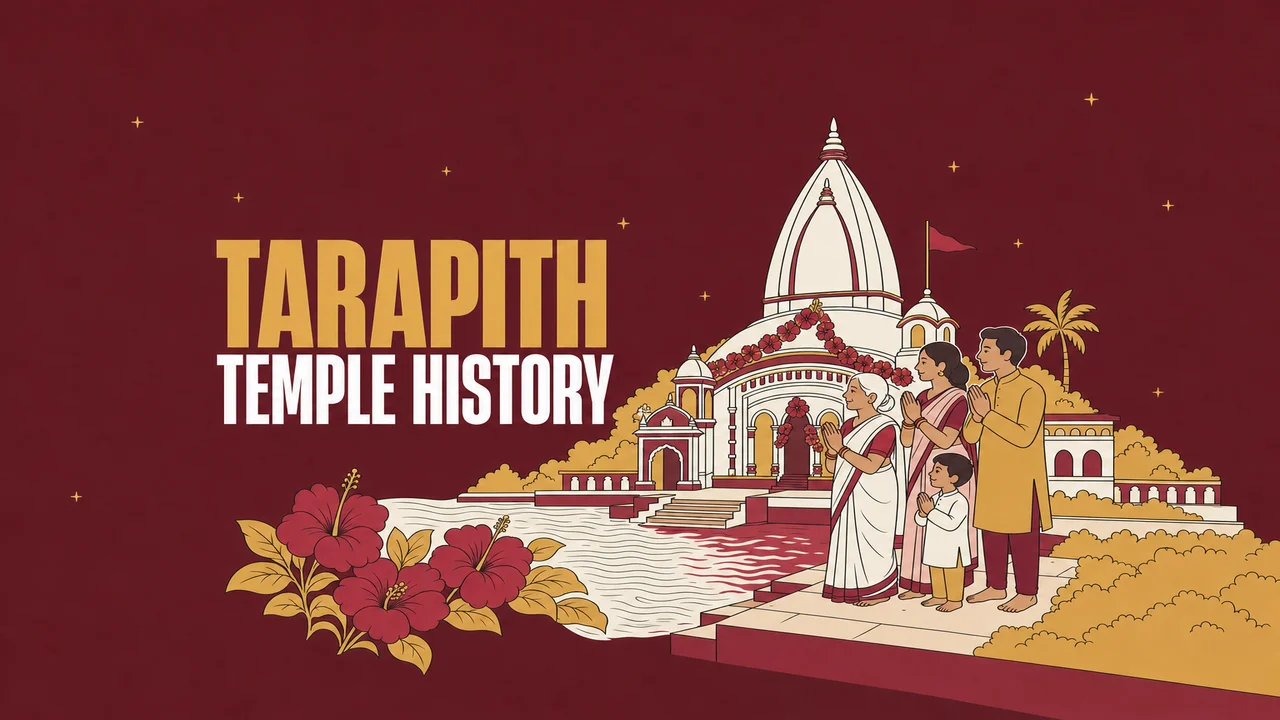
On the bank of the Dwarka river in Birbhum, West Bengal, stands one of the most powerful seats of the Divine Mother in India: Tarapith, the home of Maa Tara. It is a place of legends, of the sage Vashishtha and the saint Bamakhepa, and of a cremation ground where Tantric seekers have meditated for centuries. Here is the history of Tarapith temple, told simply.
- Deity: Maa Tara, the second of the ten Mahavidyas
- Where: Tarapith, Birbhum district, West Bengal, about 9 km from Rampurhat Junction
- Known as: a Shakti Peeth by popular tradition, and a Siddha Peeth, a seat where seekers attain siddhi
- Present temple: built in 1818 by Jagannath Ray, zamindar of Mallarpur, by the most cited account
Who is Maa Tara?
Maa Tara is the second of the Das Mahavidyas, the ten great wisdom forms of the Divine Mother. Her name means the one who carries devotees across, Tarini, the saviour who takes them over the ocean of suffering. In her fierce form, Ugra Tara, she is dark blue, stands on a pyre and holds the power of time and dissolution; to her devotees she is also the most loving mother.
That is why Tarapith is both a temple of motherly grace and one of India's foremost centres of Tantric worship, with the great cremation ground, the Mahashmashan, beside it.
Shakti Peeth or Siddha Peeth?
The popular tradition, followed by most devotees and many temple guides, says that when Lord Vishnu's Sudarshan Chakra divided the body of Devi Sati, the pupil of her third eye, the nayan tara, fell in the forest of Chandipur. The place came to be called Tarapith, the seat of Tara.
Some scholars and scripture-based accounts disagree. They say no part of Sati's body fell here, and call Tarapith a Siddha Peeth: a seat made holy because great sadhaks attained siddhi here. Both views agree on what matters to devotees: Tarapith is a Mahapeeth, one of the most powerful places in India to worship the Mother.
The legend of Vashishtha
The best-known story of Tarapith is that of the sage Vashishtha. As the Tantric texts tell it, Vashishtha worshipped Tara for a very long time, but his sadhana did not bear fruit. A divine voice sent him to the far north, to Mahachina, where, the stories say, he learned the vamachara way of worshipping Tara.
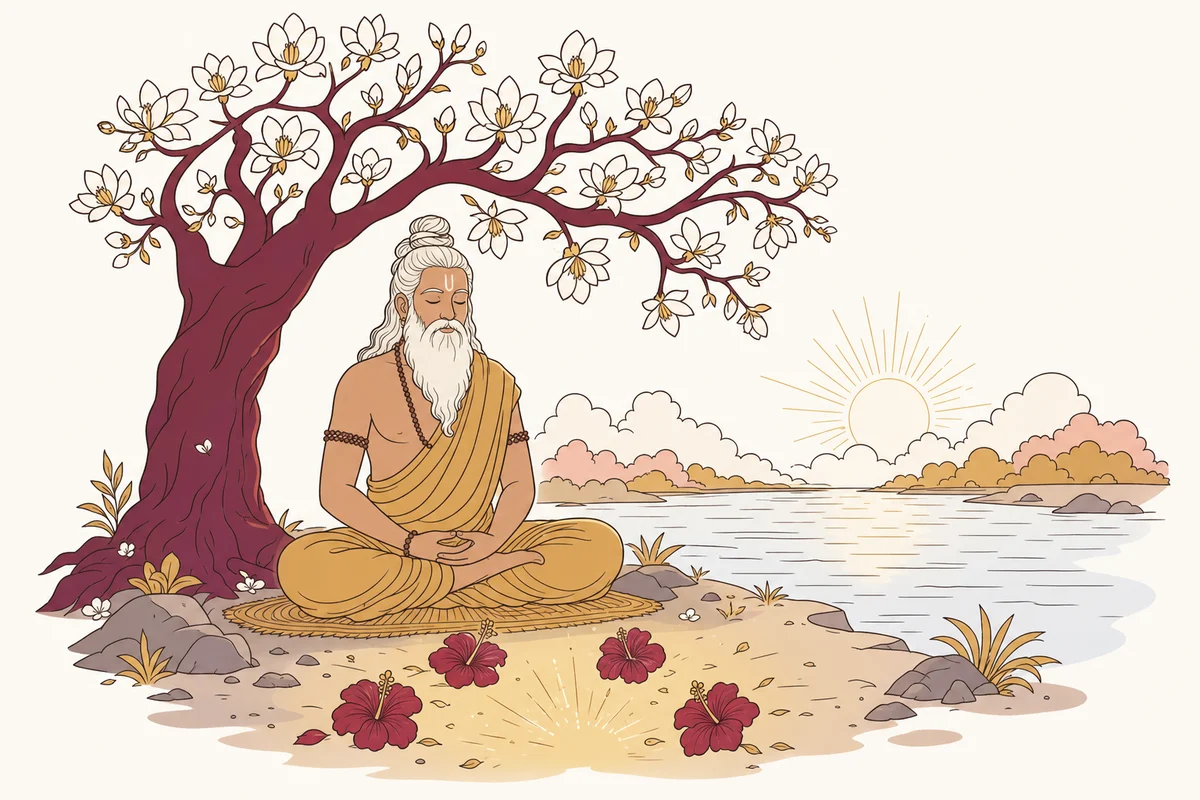
He returned to Tarapith and sat on a seat of five skulls, the Panchamundi asan, beneath a white silk-cotton tree (shwet shimul) by the Dwarka. There Maa Tara appeared to him. Tradition says he asked to see her as the mother nursing Shiva, and in that form she became the stone image worshipped at Tarapith ever since.
Why Tara nurses Shiva
The image recalls another story. When the gods and demons churned the ocean, the deadly poison halahal rose first, and Lord Shiva drank it to save the world. The poison burned within him, and Maa Tara took him on her lap and nursed him like a child, healing him. At Tarapith she is worshipped as that mother.
The stone image and the silver mask
Inside the sanctum, the ancient stone image of Tara nursing Shiva is kept covered by a metal image about three feet tall, with three eyes, a silver crown and garlands of flowers. Most devotees see this outer form, its face red with sindoor. The stone itself, the Brahmashila, is said to have been found beneath the white shimul tree where Vashishtha meditated.
Jaydatta, Jeevan Kund and the first temple
A local legend tells of a merchant, Jaydatta, whose son died of a snakebite near Tarapith. When the boy's body touched the water of a pond here, he came back to life. The pond is still called Jeevan Kund, the pond of life, and the grateful merchant is said to have built the first temple to Maa Tara.
The temple standing today was built in 1818 by Jagannath Ray, zamindar of Mallarpur in Birbhum, by the account most sources give. It has been repaired and renovated many times since, most recently in the 2020s.
Sadhak Bamakhepa, the mad saint of Tarapith
No name is more tied to Tarapith than Bamakhepa, born Bamacharan Chattopadhyay in 1837 in the nearby village of Atla. He came to Tarapith as a young man and spent his life in devotion to Maa Tara, whom he called Bara Ma, the elder mother. People called him khepa, the mad one, for his wild, childlike love of the goddess, which ignored every rule of ritual.
He meditated on the same Panchamundi asan in the cremation ground, and devotees believe Maa Tara appeared to him there. Stories say he would eat from the goddess's bhog before it was offered, and that the temple came to accept it because he was her son. Bamakhepa left his body in 1911; his ashram and samadhi near the temple are visited by almost every pilgrim.
For many Bengali families, a visit to Tarapith is not complete without stopping at Bamakhepa's ashram after Maa Tara's darshan.
The Mahashmashan
Behind the temple, along the Dwarka, lies the Mahashmashan, the great cremation ground. In Tantric belief Tara loves the cremation ground, and the burning pyre is her seat, a symbol of the fire of knowledge that burns away ego. Seekers still meditate here, especially on new-moon nights. The beliefs that link the temple's day to the pyres here are told in our guide Tarapith temple mystery: a body every morning and at 4 PM.
Festivals at Tarapith
- Kaushiki Amavasya: the new moon of Bhadra (usually August–September), the biggest night of the year, when devotees and sadhaks gather for worship through the night.
- Tara Jayanti: Maa Tara's day, celebrated in Ashwin, the day before Kojagari Lakshmi Puja.
- Kali Puja: on the new moon of Diwali.
- Every Amavasya: each new moon draws large crowds.
Visiting Tarapith today
The temple opens early in the morning and closes at night, with a break around midday for bhog. Rampurhat Junction, about 9 km away, has trains from Howrah and Sealdah. For hours and travel, see Tarapith temple timings and how to reach Tarapith.
MandirMay is bringing Tarapith to its temple list soon, with help for darshan, stay and local travel. Until then, explore the temples we already serve.
Frequently asked questions
What is the history of Tarapith temple?
Tradition says the sage Vashishtha attained siddhi here and saw Maa Tara as the mother nursing Shiva, the form of the stone image. A merchant, Jaydatta, is said to have built the first temple; the present temple was built in 1818 by Jagannath Ray, zamindar of Mallarpur.
Is Tarapith a Shakti Peeth?
By popular tradition, yes: the pupil of Devi Sati's third eye is said to have fallen here. Some scripture-based accounts say no part of Sati fell here and call Tarapith a Siddha Peeth instead. Devotees honour it as a Mahapeeth either way.
Why is the goddess at Tarapith shown nursing Shiva?
When Shiva drank the poison from the churning of the ocean, Maa Tara nursed him like a child and healed him. Tradition says she took this form for Vashishtha and became the stone image of Tarapith.
Who was Bamakhepa?
Sadhak Bamakhepa, born Bamacharan Chattopadhyay in 1837 at Atla near Tarapith, was a saint devoted to Maa Tara who meditated in the cremation ground and lived at the temple. He died in 1911; his ashram is near the temple.
What is Jeevan Kund at Tarapith?
A pond near the temple where, by legend, the merchant Jaydatta's son came back to life after a snakebite. It is named the pond of life.
What is the biggest festival at Tarapith?
Kaushiki Amavasya, the new moon of Bhadra, usually in August or September, when worship goes on through the night.