

Arriving in Varanasi: What Nobody Tells You
Varanasi is an easy city to reach and a difficult city to arrive in. Flights land at Babatpur, trains stop at four different stations, and then the map stops helping — because a large part of the old city cannot be reached by any vehicle at all.
Every year, families book a room advertised as five hundred metres from Kashi Vishwanath, land at midnight with suitcases and elderly parents, and find out that five hundred metres means a twenty-minute walk through lanes where a cycle rickshaw struggles to pass. This guide is about avoiding that, and about what MandirMay handles so you do not have to.
The Barricade Rule
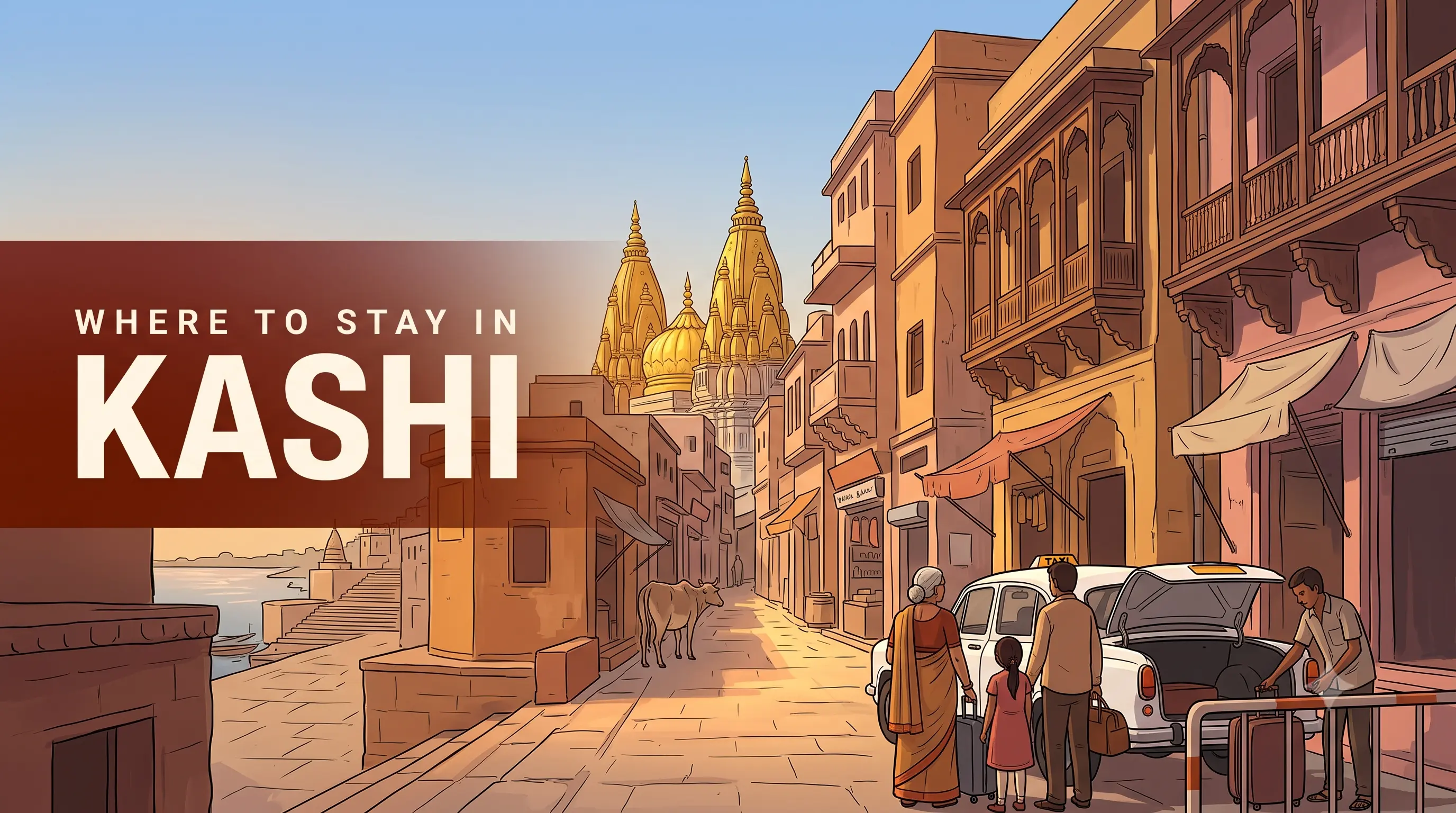
The ghat-side lanes running from Assi Ghat up to Manikarnika are closed to vehicles. No taxi, auto or e-rickshaw enters. Your driver stops at the nearest barricade — most often the Godowlia crossing — and the rest is on foot.
Before confirming any hotel booking, ask two questions and expect plain answers:
- Where exactly will my vehicle stop? Get the barricade name, and forward it to your driver in advance.
- How many minutes is the walk from there? Anything over ten minutes changes what luggage you should bring.
A property that cannot answer these clearly is telling you something useful about how the arrival will go.
Reaching Varanasi by Air
Lal Bahadur Shastri International Airport (VNS) at Babatpur is the only airport. It sits roughly 22 km from the Cantonment side and 25 to 26 km from the ghats, which is 45 to 60 minutes in ordinary traffic and considerably longer between 9 AM and noon or 4 to 7 PM.
Indicative market fares, checked on 7 August 2026:
- Airport to Dashashwamedh or Godowlia: around ₹700 to ₹950 by sedan, ₹950 to ₹1,200 by SUV.
- Airport to Varanasi Junction, Cantt: around ₹620 to ₹900 by sedan.
- Airport to Assi Ghat or Bhelupur: around ₹800 to ₹1,000 by sedan.
- Night pickup after roughly 9 PM: add ₹150 to ₹300.
- Shared autos on fixed routes: ₹15 to ₹30 per person, the cheapest option in the city.
These are ranges, not fixed prices, and they move with season and festival dates. Before agreeing to any fare, ask whether toll, night charge and driver allowance are included — that gap is where a quoted price and a final price usually part ways.
Reaching Varanasi by Train, and the Station Most People Miss
Choosing the right rail head changes your arrival more than choosing the right hotel does.
- Varanasi City Station (BCY): the closest rail hub to the ghats and the Vishwanath corridor, roughly 400 to 600 metres away. Fewer trains halt here, so most travellers never think to look. If your train stops at BCY, take it.
- Varanasi Junction (BSB), also called Cantt: the busiest station with the widest choice of trains, about 5 km from the temple, and by far the most chaotic exit.
- Banaras (BSBS), formerly Manduadih: calmer, easier for cab pickup, convenient for the Lahartara side.
- Pt. Deen Dayal Upadhyaya Junction (DDU): a major junction across the river, good for connections but a longer road transfer.
A warning about Varanasi Junction. The main exit is thick with auto drivers and hotel touts. A standard approach is to tell you your hotel is closed, full, or has shifted, and then take you somewhere that pays a commission. Walk past and do not engage. The prepaid taxi counter generally shuts around 10 PM, after which fares climb steeply. If you have pre-booked, go straight to your driver and confirm the fare, vehicle number and drop gate in writing before boarding.
Choosing Your Area
Varanasi is really two cities: the vehicle-free old lanes with all the atmosphere, and the newer zones with all the infrastructure. Pick according to who is travelling, not according to distance on a map.
- Corridor and Lahori Tola — two to eight minutes' walk from the temple gates. The right choice if darshan is the priority, particularly for a pre-dawn Mangala Aarti slot. No vehicle access, and rooms are frequently small with stairs only.
- Godowlia — ten to fifteen minutes' walk. Budget stays, strong connectivity, close to Dashashwamedh. Loud around the clock.
- Assi Ghat — twenty to twenty-five minutes by auto to the temple. Quieter at night, right on the river for sunrise boats and the Subah-e-Banaras aarti. The safest default for a first visit.
- Bhelupur and Ravindrapuri — fifteen to twenty minutes by auto. Residential and calm, and vehicles reach the door. The sensible choice for families and elderly travellers.
- Cantonment — twenty-five to thirty-five minutes by taxi. Lifts, parking, chain hotels, next to the Junction and the airport road. Furthest from the atmosphere people travel for.
On elderly parents: do not book inside the old city. The lanes are vehicle-free and crowded at every hour, and the buildings are typically narrow and vertical with stairs and no lift. Bhelupur, Ravindrapuri or Cantt with a vehicle held for you is far kinder, and the short assisted walk at the end is manageable.
The Last Stretch
However you arrive and wherever you stay, the final approach to Kashi Vishwanath is on foot. A few things that make it easier:
- Travel light if you are staying in the old city. A hard-shell suitcase over uneven stone is a genuinely unpleasant twenty minutes.
- Porters wait near the barricades. Agree the amount before handing anything over, or have it arranged in advance.
- Leave large luggage at the hotel or with your driver before darshan. Phones, cameras, bags and leather items cannot enter the temple, and the free lockers near the gates are sized for personal belongings, not suitcases.
- Arriving by boat is the pleasant alternative — the corridor runs up from Lalita Ghat directly to the temple.
When to Book
Two to three weeks ahead is comfortable for ordinary dates. Three periods break that rule entirely:
- Shravan — 29 July to 29 August in 2026. Rooms near the ghats fill and rates climb sharply.
- Dev Deepawali — 24 November 2026. The hardest night of the year for riverside rooms and for boats. Book months ahead.
- Mahashivratri — the other peak, when the corridor area is at its most crowded.
October to March is the most comfortable window overall. April to June is severe, and during monsoon the river runs high enough that some ghats and boat routes are restricted.
What MandirMay Arranges
Darshan and aarti tickets are issued by the Shri Kashi Vishwanath Temple Trust alone, through its official portal. Everything around the trip is where a local team saves you the friction:
- Airport and station pickup with a driver who knows which barricade serves your specific hotel.
- Hotel arrangement by area — and an honest answer if the room you are considering is wrong for your group.
- Porter coordination arranged beforehand rather than negotiated on arrival with luggage in hand.
- Local sightseeing covering Sarnath, Kaal Bhairav, Sankat Mochan and Ramnagar Fort, with a vehicle held for you.
- Boat rides at a rate fixed in advance, not settled on a crowded ghat at six in the evening.
Send your dates and who is travelling, and you will receive the recommended area and a full quote in writing before anything is paid.
Frequently Asked Questions
Can a taxi drop me at my hotel near Kashi Vishwanath Temple?
Usually not. The lanes from Assi Ghat up to Manikarnika are closed to vehicles. Taxis stop at a barricade, most often Godowlia crossing, and you walk the last stretch with your luggage — anywhere from five to twenty minutes depending on the property. Confirm the exact drop point and the walking distance before you book.
Which railway station is closest to Kashi Vishwanath Temple?
Varanasi City Station, code BCY, at roughly 400 to 600 metres from the ghats and the corridor. Most travellers only consider Varanasi Junction, which is about 5 km away and much more chaotic on arrival.
How much is a taxi from Varanasi airport to the ghats?
Around ₹700 to ₹950 by sedan and ₹950 to ₹1,200 by SUV for the roughly 26 km run to the Dashashwamedh and Godowlia side, taking 45 to 60 minutes. Rides to the Cantonment area are shorter at about 22 km.
Is there a night surcharge on Varanasi taxis?
Yes, generally ₹150 to ₹300 for pickups after about 9 to 10 PM. Railway station prepaid counters also tend to close by around 10 PM, after which fares rise sharply. Pre-booking avoids both.
Which area should elderly travellers stay in?
Bhelupur, Ravindrapuri or Cantonment, with a vehicle arranged. The old city near the temple is vehicle-free, crowded at all hours, and its hotels are usually stair-only buildings without lifts.
What is the best area for a first-time visitor?
Assi Ghat. Quieter at night, easier to navigate than the dense old-city pockets, and on the river for sunrise boats. The trade-off is a twenty to twenty-five minute ride to Kashi Vishwanath, which matters if you hold an early Mangala Aarti ticket.
How far ahead should I book a Varanasi hotel?
Two to three weeks for ordinary dates. For Shravan, Mahashivratri and Dev Deepawali — the last falling on 24 November 2026 — rooms near the ghats go months in advance and rates multiply.
Are there touts at Varanasi Junction?
Yes. Expect to be told your hotel is closed, full or relocated so you can be taken somewhere paying commission. Walk past without engaging, and if you have pre-booked, go directly to your driver.
Can MandirMay book my Kashi Vishwanath darshan ticket?
No, and no honest operator can. Darshan and aarti tickets come solely from the Shri Kashi Vishwanath Temple Trust through its official portal. MandirMay arranges transfers, hotels, porters, sightseeing and boat rides, and advises on choosing the right slot and gate.
What is the best time of year to visit Varanasi?
October to March for comfortable weather on the ghats and in the corridor. Summer from April to June is severe, and monsoon raises the river enough to restrict some ghats and boat routes.
MandirMay is an independent travel and puja services provider and is not affiliated with, endorsed by, or acting on behalf of the Shri Kashi Vishwanath Temple Trust. Darshan and aarti tickets are issued solely by the Trust through shrikashivishwanath.org. Taxi, auto and hotel figures on this page are indicative market ranges checked on 7 August 2026, not fixed prices, and vary by season, festival dates and operator.